


Thyroid cancer - Radiofrequency - Puncture - Diagnosis - Treatment
thyroid cancer
Thyroid cancers represent 1 to 1.5% of all cancers with a strong female predominance (sex ratio RT: 6 to 7 to 1).
The thyroid is a complex organ made up of several types of cells that produce different hormones.
Each type of thyroid cell can cause thyroid cancer.
When cancer develops from follicular cells, the disease is called (differentiated follicular strain thyroid cancer).
This type of cancer accounts for more than 90% of thyroid cancer cases.
There are 2 main forms: » papillary forms (80% of cases) vesicular forms (10% of cases)
Medullary cancer (5-10%) develops at the C-cell level.
There are also anaplastic or undifferentiated types of cancer. These are more serious but, fortunately, very rare.
There are 4 main categories of thyroid cancer:
-
papillary cancers: 70%
-
gallbladder cancers: 10% (or follicular)
-
medullary carcinomas: 5% (1/3 of medullary cancers are of hereditary origin)
-
Anaplastic cancers: 5%
-
island cancers; 1-4%
Finally more rarely lymphomas, metastases, sarcomas, squamous cell carcinomas.
The diagnosis of thyroid cancer is a bundle of arguments based on the ultrasound appearance (EU TIRADS score) and on cytopuncture.
The EU TIRADS score makes it possible from the ultrasound appearance to predict the risk of cancer
Score 5 corresponds to a very high cancer risk of 26 to 87% depending on the number of cardinal signs.
Score 4 corresponds to an intermediate risk of 6 to 17% depending on the number of accessory signs.
Score 3 corresponds to a low risk of 2 to 4.
Score 2 corresponds to a benign nodule.
Ultrasound signs in favor of malignancy and the EU TIRADS score:
The EU TIRADS score is based on two elements:
-
The cardinal signs are 4: the presence of a single cardinal sign places the nodule in the category EU TIRADS 5 (depending on the number of cardinal signs the risk varies between 26 and 87%).
-
In the absence of cardinal signs, echogenicity will determine the EU TIRADS 4, 3 and 2 score:
-
Hypoechoic nodule without any cardinal sign: scoreEU TIRADS 4.
-
Iso or hyperechoic nodule without any cardinal sign: scoreEU TIRADS 3.
-
Fluid and/or spongiform nodule: scoreEU TIRADS2.
Accessory signs will modulate the risk within each group (cancer risk of 17 – 0%).
The cardinal signs (EU TIRADS score 5)
There are four cardinal signs of thyroid cancer
-
The shape of the nodule: not oval, thicker than wide and/or wide.
-
The contours of the nodule: irregular: spiculated or lobulated.
-
The echogenicity of the nodule: marked hypoechogenicity.
-
The microcalcifications.
The presence of one of the cardinal signs places the nodule in category 5.

The EU TIRADS score is based on cardinal signs and accessory signs.
The cardinal signs will classify the nodule in a category and the accessory signs will modulate the risk within each category.
-
The non-oval nodule shape
The non-oval shape is a suspicious sign therefore nodule classified EU TIRADS 5.

Oval shape

Oval shape

Non-oval shape

Non-oval shape
-
The contours of the nodule, irregular: spicules or lobules
It takes at least three spiculations or three lobulations.

Regular contours

Lobulated contours

Spiculated contours

Lobulated contours
-
The strong hypoechogenicity

Strong hypoechogenicity

Strong hypoechogenicity
The strong hypoechogenicity of the nodule is a cardinal sign and the hypoechogenicity must be compared to the superficial muscle and not to the healthy thyroid parenchyma.
-
Microcalcifications
Hyperechoic, rounded or rarely linear pits measuring less than 1 mm in diameter without shadow cone or comet-tail artifact.

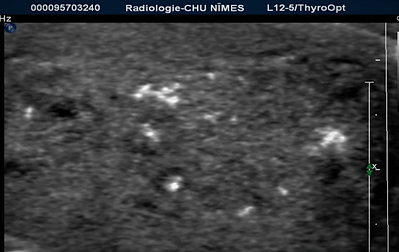
It is necessary to take into account their number and their grouping (at least 5).
Do not confuse the microcalcifications with the coloid type images at the level of the nodules.

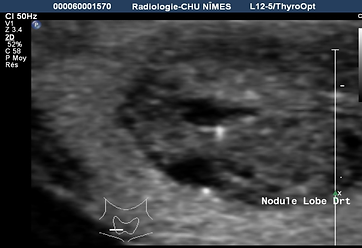
Microcalcifications
Linear hyperechoic pitting with a comet-tail artifact
Macrocalcifications are not specific to malignancy and their presence must be related to the other ultrasound signs present.


Peripheral Microcalcifications


The presence of cardinal signs at the level of a nodule means a very high risk of cancer which varies according to the number of signs present between 26% and 87%.
Beware of the fake EU TIRADS 5 score.
It is a highly hypoechoic nodule without any internal vascularization and this aspect is the consequence of the complete absorption of the intra-nodular haemorrhagic fluid component.


Accessory signs
Some accessory signs increase the risk of cancer and others decrease the risk.
These signs participate in the modulation of the risk within each EU-TIRADS score without modifying it.
Accessory signs that increase the risk are:

Discontinuous peripheral macrocalcifications

Pathological elastography

Round shape
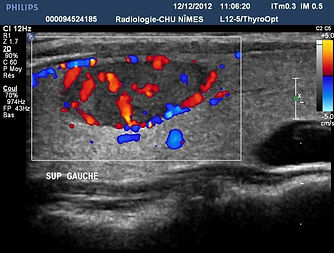
Central vascularization

Non-parallel orientation

Extra capsular extension
Accessory signs that decrease the risk of malignancy are:

Fine and complete halo
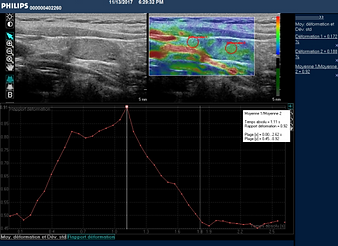
Normal elastography

Peripheral vascularization

Mixed echostructure

colloidal granulation
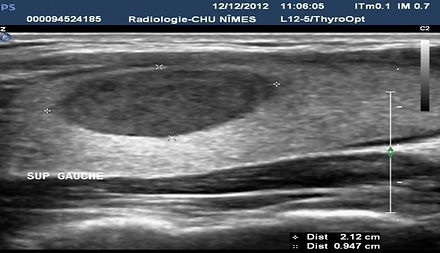
flattened shape
The vascularization
Controversial value in the literature, vascularization is not retained in the EU TIRADS system.
The vascularization provides few diagnostic arguments, however in isoechoic solid nodules > 20 mm with strong central vascularization, the risk of follicular cancer increases, on the other hand a peripheral vasculature decreases the risk.

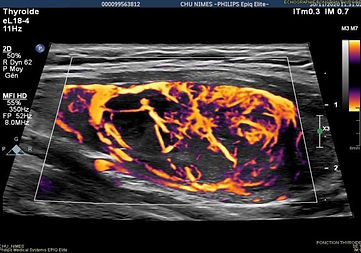
The EU TIRADS score is based on echogenicity.

-
The EU TIRADS 4 score
Moderately hypoechoic nodule compared to the superficial muscle.
Theoretical risk 6-17%.


-
The EU TIRADS 3 score
Hyperechoic or isoechoic nodule.
Theoretical risk 2-4%.


-
The EU TIRADS 2 score
Cystic nodule colloidal type or a spongiform type nodule.
Theoretical risk 0%.


About 5% to 10% of nodules are cancerous and the frequency of cancers has been increasing for 30 years. Occult cancer is even more frequent (18% in Japan, 36% on autopsies in Finland). This high frequency is to be compared to the very low mortality from thyroid cancer.
Papillary cancer EU TIRADS 5
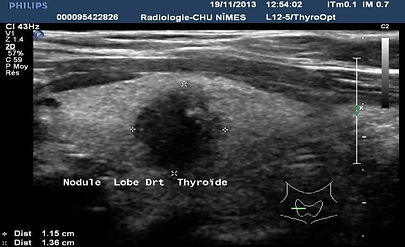

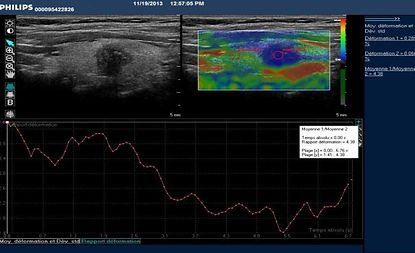
Papillary cancer EU TIRADS 5


Papillary cancer EU TIRADS 5


Two types of quantitative and semi-quantitative elastography.


Papillary cancer EU TIRADS 5
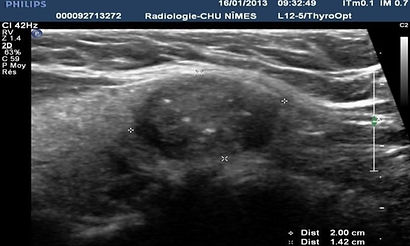

Microcalcifications
Capsule breakage
Papillary cancer EU TIRADS 5


Well-differentiated papillary cancer with a dominant liquid component.
Nodule suspected of malignancy on cytology.


Gallbladder cancer EU TIRADS 4


Follicular cancer (EU TIRADS 5)


Bone marrow carcinoma (EU TIRADS 3)


Bone marrow cancer: (EU TIRADS 4)

Bone marrow cancer (EU TIRADS 5)


Two forms of thyroid cancer: the nodular form and in a multi-nodular goitre.
Insular thyroid cancer is an extremely rare tumor (4% of cases) with a poor prognosis and intermediate malignancy between that of differentiated and anaplastic cancers


Thyroid cancer will be classified as pTNM.
